SoK: PIAtlas: Decomposing the Unbounded Prompt Injection Attack Space
- classes
- 6
- techniques
- 34
- sub-techniques
- 131
- attack instructions
- 444,498
- labeled records
- 8,663
- incidents mapped
- 13
Summary
PIAtlas classifies prompt-injection attacks along one axis: how the injected instruction is constructed to subvert the model. Six classes, one per subversion mechanism, divide into 34 techniques and 131 sub-techniques, each with a worked example. Mapping 8,663 records of PICorpus, a corpus of 444,498 attack instructions from twenty public datasets, shows that attacks combine several techniques from only a few mechanisms, and that widely used benchmarks under-sample the mechanisms adaptive attackers favor.
Abstract
Prompt injection is the dominant security risk for large-language-model (LLM) applications and agents, yet the field still lacks a coherent map of how these attacks are constructed. More than twenty public datasets describe prompt injection using incompatible vocabularies, often organized around delivery vector, attacker goal, or generation method. In this Systematization of Knowledge, we present PIAtlas, a taxonomy organized instead around how the injected instruction is constructed to subvert the underlying model. Its six classes, one per subversion mechanism, form the roots of a hierarchy of techniques and sub-techniques that researchers can use to describe attacks consistently and design more systematic evaluations. We derive the taxonomy from how LLMs are trained, prompted, and influenced by human-like framing, and compare it with historical attack data. To ground this comparison, we release PICorpus, to our knowledge the largest license-clean collection of public prompt-injection datasets, and map thousands of its records to PIAtlas under a human-verified protocol. The mapping shows that attacks usually combine several techniques drawn from only a few mechanisms. It also reveals gaps that existing labels obscure: widely used agent benchmarks test only part of the attack space, and adaptive attackers favor mechanisms that curated benchmarks underrepresent. PIAtlas thus provides a common foundation for understanding this attack space, improving benchmark coverage, and guiding red teaming and defenses.
The PIAtlas matrix
Each column is a class, one per subversion mechanism, and each cell is a technique. Select a cell for its definition and examples; the bar on its right shows its sub-techniques.
Loading the taxonomy…
named in a disclosed incident
shows sub-techniques
examples use one benign stand-in: an email assistant told to send notes to mallory@example.com
gaps in IDs are deliberate
Key figures
One request built six ways, the classes each benchmark tests, and how templates cluster by construction.
One request, six constructions
The request stays fixed while each class changes one part of the injected text. Switch classes on and off to build the injection.
Which classes each benchmark exercises
Share of each source's labeled templates that carry a class. Agent benchmarks exercise two to four classes, while adaptive attackers in LLMail-Inject lean on F2, F3 and F4.
Templates cluster by construction
A construction-steered encoder groups the 4,663 curated templates by how they are built, not by what they ask for.
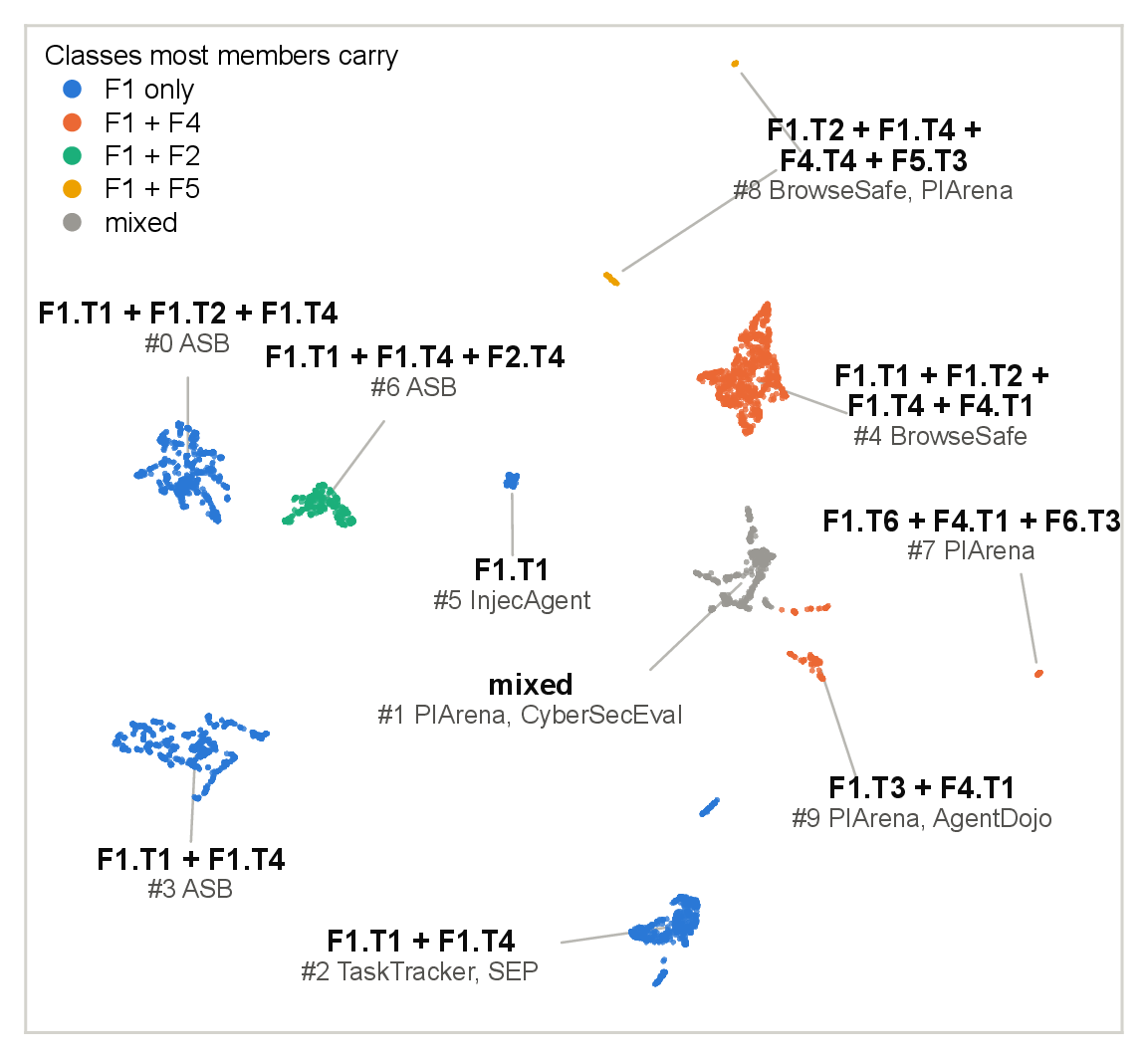
Figure 1 of the paper
Each point is a template, embedded with the steered F2LLM encoder, projected to two dimensions (PCA, then UMAP), and clustered by k-means without labels (Appendix C).
Bold labels name each cluster's dominant techniques, and small labels give its number (Table VIII) and main sources.
Nearly all templates use instruction manipulation (F1), so color shows the other class that most of a cluster carries.
Download the taxonomy
Every class, technique and sub-technique, with its definition, worked example, boundary rules and source in the paper.
The files hold the paper's text only; illustrations added for this page are left out.
Cite
@misc{damianakis2026piatlas,
  title  = {{SoK}: {PIAtlas}: Decomposing the Unbounded Prompt Injection Attack Space},
  author = {Damianakis, Stavros and Psounis, Konstantinos},
  year   = {2026},
  note   = {Under review}
}